Precision at 1mm: why brunoise is the hardest cut in the kitchen
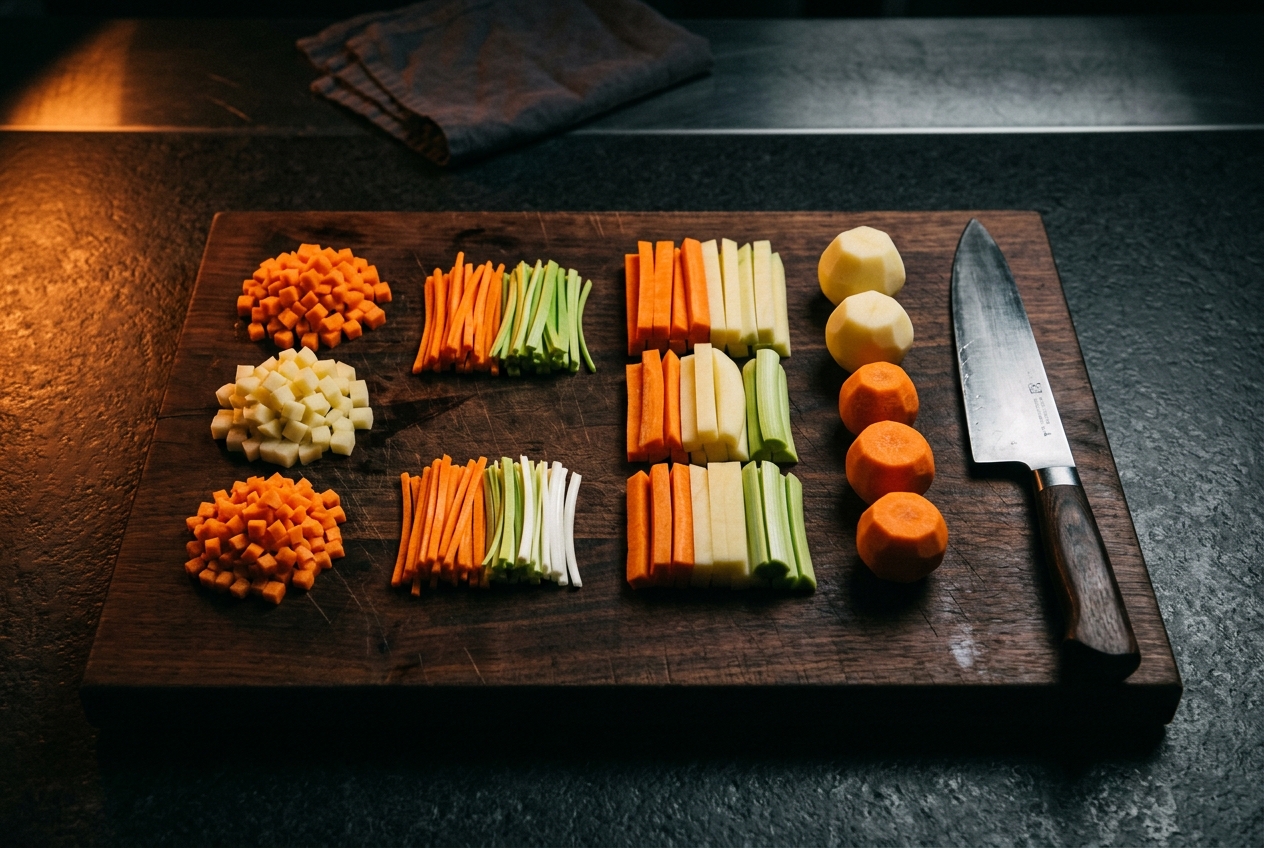
Every commis chef spends their first month weeping over a pile of carrots. You cut them into batons. You slice them into thin strips. The sous chef sweeps them into the bin because they are 2mm wide instead of 1mm.
It feels like hazing. It isn't. It's thermodynamics.
The math of cooking times
When you drop vegetables into a hot liquid or fat, heat travels from the surface to the centre.
* If you have a carrot cut into 1mm cubes (brunoise) next to a 3mm cube, the 1mm cube cooks in seconds. The 3mm cube takes three times as long.
* By the time the larger pieces are cooked through, the smaller ones have dissolved into mush, clouding your consommé or ruining the texture of your sauce.
Precision cuts are not showmanship. They make every piece in the pan cook at the same rate.
The classic French progression
To get a perfect brunoise, you must master the building blocks in order:
1. Le Tronçon (The Log)
Before you make a single cut, square off your vegetable. Cut it into uniform blocks exactly 5cm long. If your block is curved or uneven, your final cuts will be too.
2. La Tranche (The Slice)
Slice the squared block lengthwise into sheets. For julienne, these sheets must be exactly 1mm to 2mm thick. Keep your guide hand's fingers tucked in, knife resting against your knuckles.
3. La Julienne (The Matchstick)
Stack the sheets and slice them lengthwise at the same thickness. You now have uniform matchsticks. If they look like different sizes, stop and adjust your knife angle.
4. La Brunoise (The Cube)
Gather the julienne matchsticks tightly together. Cut across them at 1-2mm intervals. You should end up with tiny, perfect cubes.
The Tourné (The seven-sided football)
The tourné is the ultimate test of wrist movement. You carve root vegetables into a 5cm long, seven-sided barrel shape with curved faces. It takes hours to learn.
In modern kitchens, we do it less for style and more because the curved shape allows vegetables to roll easily in a glaze, coating them evenly without breaking their edges.
The knife matters
You cannot make precision cuts with a dull knife. A dull blade slips, crushes cell walls (which releases moisture and makes vegetables soggy), and ruins your clean lines.
Keep a whetstone on your station. Sharpen before every service.
You get fast at this by getting accurate first. The speed turns up on its own later, always later than you want it to.